Catholic Funeral Program Template, Built for the Mass
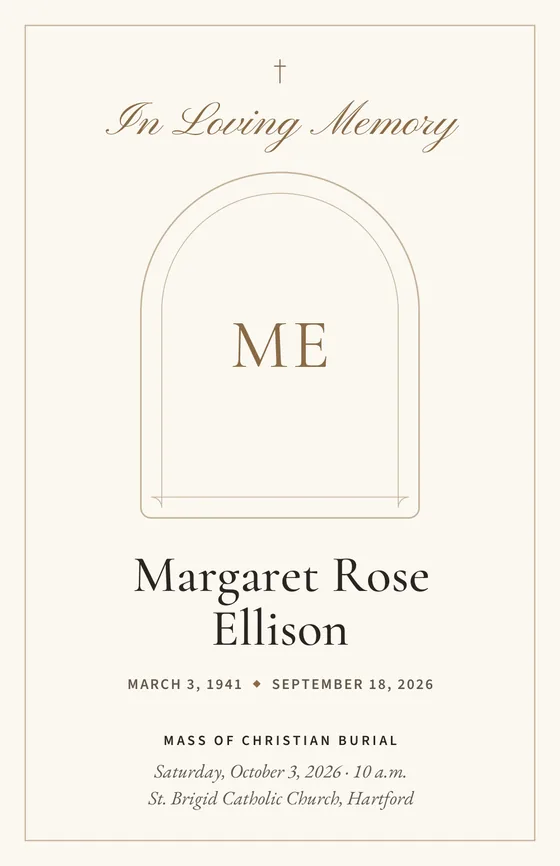
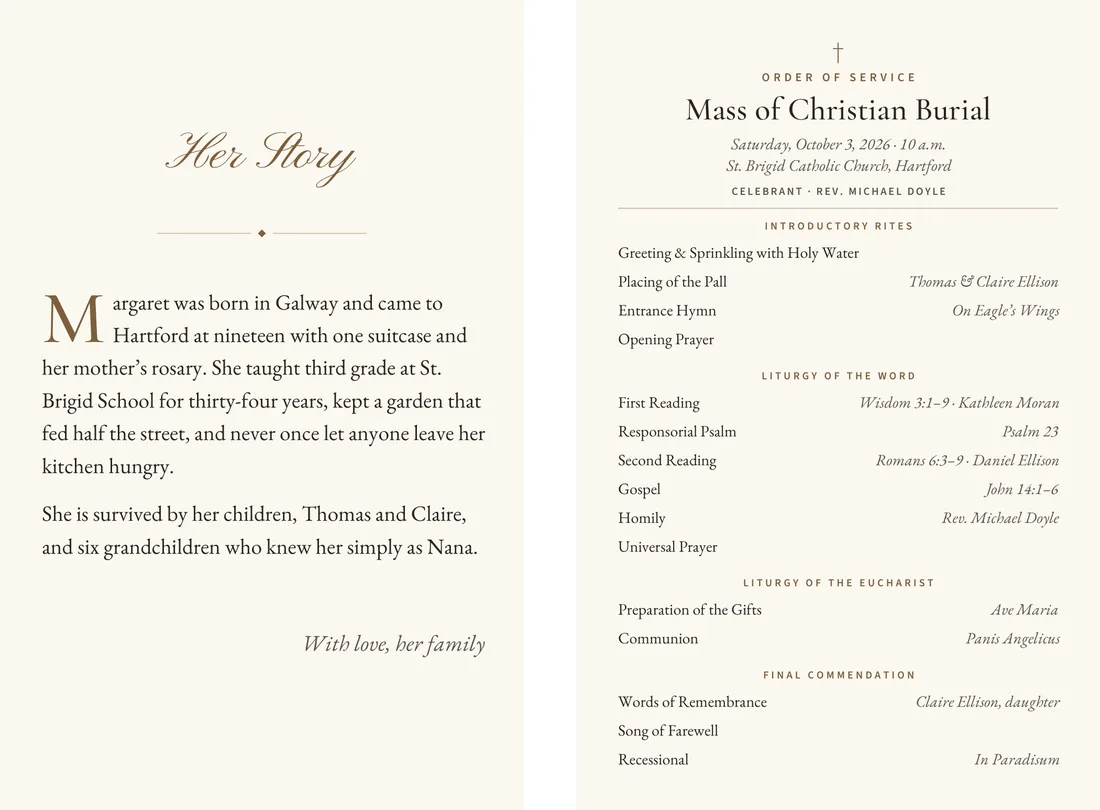
This template follows the structure of a Catholic funeral Mass in the Order of Christian Funerals: the Introductory Rites, the Liturgy of the Word (first reading, responsorial psalm, second reading, Gospel, homily), the Liturgy of the Eucharist, and the Final Commendation and Farewell. Fill in your celebrant, readers, hymns and readings, and Candlefold lays it out on a letter-size bifold, ready to print at home or at a print shop.
Every parish handles some details differently. This page describes the general structure of the Order of Christian Funerals; confirm the specifics with your own priest or deacon, who chooses the readings and prayers with your family.
What’s the order of a Catholic funeral Mass?
| Part | What happens |
|---|---|
| Introductory Rites | Greeting of the family at the church door, sprinkling with holy water, placing of the pall (a white cloth recalling baptism; family members may place it), entrance procession and song, sometimes the placing of a Christian symbol such as a Bible or cross, and the opening prayer |
| Liturgy of the Word | First reading (often read by a family member or friend), responsorial psalm (often sung), second reading, Gospel acclamation and Gospel (proclaimed by the priest or deacon), homily, and the prayers of the faithful |
| Liturgy of the Eucharist | Preparation of the gifts (family members may bring them forward), Eucharistic Prayer, Communion and Communion song, Prayer after Communion |
| Final Commendation and Farewell | Invitation to prayer, a time of silence, the Song of Farewell (during which the casket is usually incensed, and may be sprinkled with holy water), and the Prayer of Commendation; then the procession to the place of committal, often with the "In paradisum" or a closing song |
The first and second readings may be read by family members or friends; the Gospel is proclaimed by the priest or deacon. A funeral liturgy outside Mass follows the same outline without the Liturgy of the Eucharist. It is used, for example, when no priest is available, when the funeral is held somewhere other than a church, or on days when a funeral Mass is not permitted (holy days of obligation, Holy Thursday, the Easter Triduum, and the Sundays of Advent, Lent and the Easter season).
What goes in a Catholic program specifically?
| Field | What it needs |
|---|---|
| Celebrant | The priest’s name (or the deacon’s, for a funeral liturgy outside Mass) |
| Entrance song | Title |
| First reading | Passage and reader’s name |
| Responsorial psalm | Which psalm (for example Psalm 23 or 25) |
| Second reading | Passage and reader’s name |
| Gospel reading | Passage (proclaimed by the celebrant) |
| Homily | By the celebrant; no field needed beyond noting it happens |
| Preparation of the gifts | Song title, and who brings up the gifts if family members do |
| Communion song | Title |
| Words of remembrance | Name, only if your parish allows them at the Mass (see below) |
| Song of Farewell and closing song | Titles |
| Pallbearers | Names |
Words of remembrance. The Order of Christian Funerals has no eulogy in the usual sense, and the homily is never a eulogy. With the parish’s permission, a family member or friend may speak briefly in remembrance after the Prayer after Communion, before the Final Commendation begins. Some parishes place these words before the entrance song instead, and many suggest the vigil (wake) the night before for longer tributes. Ask your parish which is customary there.
Can I include a specific responsorial psalm?
Yes. Psalm 23 (“The Lord is my shepherd”) and Psalm 25 are both among the psalms given for funerals, but the readings and psalm are chosen with the priest or parish funeral coordinator from the texts approved for funerals, not freely from the whole Bible. Bring your preference to that conversation. In a Mass program it is usual to print only the citation of each reading, since the reader proclaims it from the parish lectionary.
What if it’s a vigil or a graveside service instead of a Mass?
A vigil for the deceased (often held at the funeral home or church the evening before) has its own order: a greeting, an opening song and prayer, a first reading, a responsorial psalm, a Gospel and a homily, prayers of intercession with the Lord’s Prayer, and a concluding blessing. A family member or friend may also speak in remembrance near the end of the vigil. Many families also pray the rosary during the visitation; the rosary is a popular devotion and is not part of the vigil service itself.
The Rite of Committal, at the grave, tomb or columbarium, is shorter: an invitation, a scripture verse, a prayer over the place of committal, the committal, intercessions, the Lord’s Prayer, a concluding prayer and a prayer over the people. For either, trim this template’s sections to match, and ask your priest or deacon which parts your family’s service includes.
What about military honors?
If the family has asked for military honors, many parishes follow the Order of Christian Funerals: the flag is taken off the casket at the church door and the casket is covered with the white pall during the Mass. The flag can go back on after the casket leaves the church, and the honors (Taps, the folding and presentation of the flag, and a rifle volley if the honor guard provides one) usually take place at the graveside. In Candlefold, the military honors lines go at the end of the order of service; ask your parish and funeral director how they do it.
Who checked this template?
Candlefold checked this page against the Order of Christian Funerals as published for the United States and USCCB guidance, through the sources listed below. It has not been reviewed by a priest, deacon or parish liturgist. If one reviews it, their name will appear here with their permission. Your own parish always has the final word on your service.
Questions families ask
What's the order of a Catholic funeral Mass?
Introductory Rites (greeting, sprinkling with holy water, placing of the pall, entrance song, opening prayer); the Liturgy of the Word (readings, responsorial psalm, Gospel, homily, prayers of the faithful); the Liturgy of the Eucharist; and the Final Commendation and Farewell (invitation to prayer, silence, the Song of Farewell and the Prayer of Commendation), followed by the procession to the place of committal.
What goes in a Catholic program specifically?
The celebrant's name, the opening and closing hymns, the readings with their readers' names, the responsorial psalm, the Gospel reading, who is giving the words of remembrance (if your parish allows them at the Mass), and the pallbearers.
Can I include a specific responsorial psalm?
Yes. Psalm 23 and Psalm 25 are both among the psalms given for funerals, but the psalm and readings are chosen with the priest or parish funeral coordinator from the texts approved for funerals. Confirm the choice with your parish before printing.
Where does a eulogy go?
The funeral rites make no place for a eulogy in the usual sense (the homily is never a eulogy). With the parish's permission, a family member or friend may give short words of remembrance after the Prayer after Communion, before the Final Commendation. Some parishes place them at the start of the Mass instead, and many suggest the vigil (wake) for longer tributes. Ask your parish.
What if it's a vigil or a graveside service instead of a Mass?
A vigil for the deceased has its own short order: greeting and opening prayer, a reading, a psalm, a Gospel and a homily, prayers of intercession with the Lord's Prayer, and a blessing. The graveside Rite of Committal is shorter still. A funeral liturgy outside Mass follows the funeral Mass without the Liturgy of the Eucharist. Ask your priest or deacon which rites your family's service includes.
Who checked this template?
Candlefold checked it against the Order of Christian Funerals and USCCB guidance (sources below). It has not been reviewed by a priest or deacon; your own parish has the final word on your service.
Sources
- USCCB: Bereavement and Funerals (checked 2026-09-27): the three funeral rites (vigil, funeral liturgy, committal) of the Order of Christian Funerals.
- Diocese of Orlando: Diocesan Norms for the Order of Christian Funerals (checked 2026-09-27): outlines of the funeral Mass, the vigil and the Rite of Committal; the pall (OCF 38); words of remembrance after the Prayer after Communion (OCF 170); the homily is never a eulogy (OCF 27); the order of the Final Commendation.
- St. Regis Parish: The Order of Christian Funerals (checked 2026-09-27): days on which a funeral Mass is not permitted; the funeral liturgy outside Mass; the vigil as the usual place for eulogies.
- Archdiocese of Newark: Use of National Flags in the Order of Christian Funerals (checked 2026-09-27): national flags are removed from the coffin at the church entrance, may be replaced after it leaves the church, and belong more appropriately to the graveside rites (OCF 38, 132).
- Catholic Cemeteries of Fairfield County (Diocese of Bridgeport): funeral FAQ (checked 2026-09-27): the rosary is a popular devotion prayed during visitation, not part of the vigil service.
How this page was checked
- Written by
- Candlefold editorial team
- Reviewed by
- Candlefold editorial review: an AI-assisted fact-check against official Catholic sources; not reviewed by a priest or deacon
- Checked against
- Order of Christian Funerals (USCCB), as summarized in diocesan norms that cite it by paragraph
- USCCB, Bereavement and Funerals
- Last checked
- Last updated
Our editorial policy explains who writes and checks the pages, and how to report a mistake. Read the editorial policy.